
From Lab to Market: Navigating the Economic Waves of Green Technologies

* Overview of green technologies and its importance:
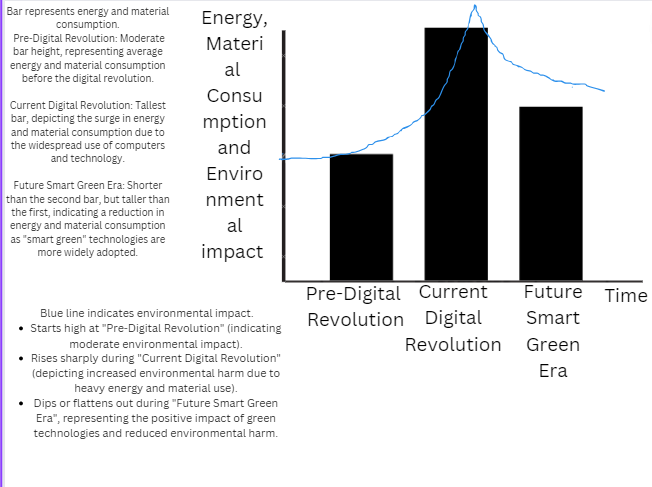
Green technologies incorporate innovative tools, applications and techniques designed to promote environment friendly practices and resource efficient operations which effectively reduce environmental harm while providing sustainable energy solutions. The digital revolution has made us use more energy and materials because of the widespread use of computers and technology. However, we are just at the beginning of this technology era, and there's a chance for "smart green" technology to help us grow in a way that’s good for the environment. (Perez) We need to make sure our policies and new ideas work together to make this happen. This approach can help us live more sustainably.
The graph below depicts the potential impact of Green Technologies.
*Investment and economic growth through green technologies:
The investment in green technology has seen a remarkable surge with total investment in low carbon technologies reaching a remarkable $755 billion in 2021, according to research by Bloomberg NEF. (Relander, 2022) The worldwide shift to clean energy highlights how adopting green technology in science and technology fields not only addresses environmental concerns but also drives investment and economic growth. An illustrious example in the context of eco-friendly energy shift is Tesla, Inc. The company is tactically guiding the worldwide move towards electric vehicles establishing a benchmark for making wealth while also managing resources in an economy that produces fewer carbon emissions. For a long time, cars have run on gas, but now we're moving towards cleaner options. Making this change isn’t easy, though. While electric cars are becoming more popular, thanks to big companies like Tesla, they still have issues, particularly with their batteries. The batteries need specific metals like lithium, and we're using a lot of it. We've made a lot of progress in the last 20 years, but there's still more work to do, especially in storing energy and dealing with the unpredictable nature of renewable energy sources. The switch to cleaner transportation is also an economic issue. Pollution from all forms of transportation costs us about $1.5 trillion, showing us that we need to move quicker to cleaner options. (Zaman,2020)
*Paradox of technological advancement and resource depletion:
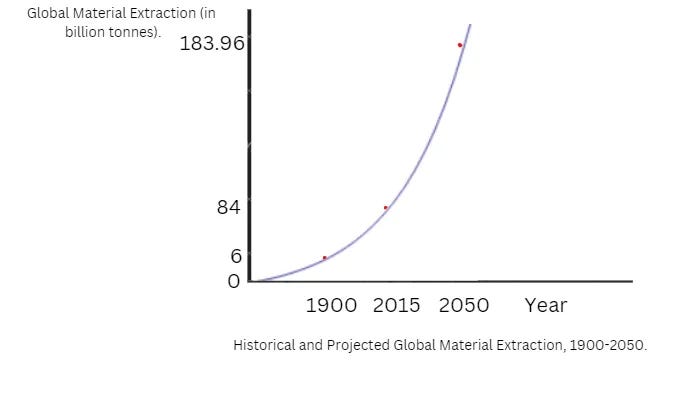
However, creating and selling green technologies must be done in a way that does not use up all our important resources, ensuring we find a balance between innovation and caring for our planet. History is a witness to the fact that each technological advancement, while introducing exciting and useful products, also results in the consumption of significantly more materials. Research from the EU shows that the world took 14 times more materials from the Earth in 2015 than in 1900, growing from 6 billion tonnes in 1900 to 84 billion tonnes in 2015, and this is expected to grow an extra 119% by 2050. (Zaman,2020,October 8) Alarming concern arises as most of the resources we use today are non-renewable and are being depleted rapidly due to excessive consumption. Companies like Tesla have demonstrated that we can create new things, make wealth and reduce pollution all together. However, because technology like electric cars needs particular metals like lithium for their batteries and our environment is always at risk, it's crucial to formulate a plan for green technologies.
*Building sustainable future through competetive advantage:
Transitioning to a sustainable future also involves looking at our energy consumption in buildings and industries. Pacific Gas and Electric (PG&E), a leading utility company, has made impressive strides towards sustainability and efficiency. By integrating energy-efficient lighting, heating, and cooling systems in the new federal building in Oakland, they've achieved annual savings of $600,000 and reduced energy consumption by nearly 6 million kilowatt-hours. (Clarke, Harvard Business Review) Additionally, their forward thinking approach to recycling operational materials like electric conductors, transformers, and plastic gas pipes has led to several million dollars in cost savings each year. Companies that succesfully implement green technologies and achieve cost savings may gain the ability to influence pricing in the market . Green Competitive Advantage is the concept of enabling companies to outperform peers by aligning business strategies with environmental goals, attracting eco-conscious customers, and saving costs. (Zhu) Successful GCA involves integrating green practices into operations, particularly sustainable supply chain management, and staying competitive through continuous innovation and responsiveness to market forces and competition responses, including replication and innovation. Companies should also build strong idea and patent portfolios, often in partnership with technology suppliers, and be ready for preemptive reinvention to maintain market relevance and drive toward sustainability.
* Continuous innovation and efficiency improvement:
We need continuous scientific innovation in an incremental fashion and new ideas for advancing green technologies making sure they work well and are efficient for the environment. A notable example is how we switched from incandescent bulbs to energy-saving LEDs. For producing 750 lumens, initially we had 60W incandescent bulbs, which were energy intensive, but science did not stop there. The pursuit of efficiency and sustainability led to the creation of LEDs, providing the same brightness at only 10W. Human beings' inherent desire to improve the world around them and their constant quest for betterment have fueled the transition from traditional incandescent bulbs, which waste up to 85% of energy, to more efficient CFLs, and ultimately to the innovation of LEDs that use 85% less energy, a breakthrough that Nobel Prize-winning research helped achieve. (Zaman,2022,May 14) This change wasn't just about new products. It was a response to the growing need for technologies that consider both economic and environmental implications. The lesson from the transition from incandescent light bulbs to LEDs shows us that we must continually make green technology better in an incremental fashion and redesign when necessary for sustaining the innovation, not just invent it and leave it at that.
*Real world application and benefits of green technologies:
A lot of energy gets wasted in industries and even when we cook on old fashioned stoves. To give an idea using numbers, like up to 30% in factories and more than 80% while burning biomass in clay cooking stoves. (Zaman,2020,July 21) We've been trying to use a special technology called thermoelectric technology to capture this lost heat and turn it into useful power for about 70 years. Right now, we can only capture about 5% of this wasted energy, which isn't a lot. This technology needs to make further advancements in offering a cost effective means of extracting wasted thermal energy. In the automotive sector, thermoelectric generators can have a revolutionary impact. As we all know, vehicles produce a significant amount of waste heat. By utilizing the thermoelectric generators, this wasted thermal energy can be transformed into useful electrical power which could lead to improving fuel efficiency and reduce emission. Thermoelectric coolers have the potential of improving in car temperature management by providing more efficient cooling or heating while using less energy than standard methods. For the aerospace industry, thermoelectric systems are appealing because of the reliability and durability of such systems. Planes need robust systems for controlling the environment and power generation. The integration of thermoelectric technology paves the way for more efficient use of fuel and less need of power from airports. In consumer electronics, the applications are wide ranging. Thermoelectric coolers can keep gadgets at the right temperature, stop them from getting too hot and enhance performance. On the other hand, thermoelectric generators offer a new way to power devices, possibly making batteries last longer by using human body heat or heat from the surroundings when used in wearable technology. (Huang) All of these increases the perceived value of the products and opens the room for market expansion.
In conclusion, while green technologies and sustainable practices present a promising pathway towards a cleaner and more efficient future, the role of technological advancement cannot be understated. However, it is crucial to recognize that the success and integration of these innovations largely depend on societal acceptance and consumer behavior. The science of interpreting consumer preferences teaches us that consumers might not fully articulate their needs, necessitating silent observation and empathy to uncover latent preferences and create genuine excitement. Necessary steps should be taken by different means to make the customers realize the potential of green technologies. As we strive to balance innovation with conservation, fostering a culture that embraces change and values sustainability becomes imperative.
References:
1)Zaman, R. (2020, July 21). Enabling Technologies for Sustainable Development—does science and technology policy matter? The Waves. Updated January 28, 2022. https://www.the-waves.org/2020/07/21/enabling-technologies-for-sustainable-development-does-science-and-technology-policy-matter/
2) Huang, L., Zheng, Y., Xing, L., & Hou, B. (2023). Recent progress of thermoelectric applications for cooling/heating, power generation, heat flux sensor, and potential prospect of their integrated applications. Thermal Science and Engineering Progress, 45, 102064. https://doi.org/10.1016/j.tsep.2023.102064
3) Zaman, R. (2022, May 14). Science for Environment and Economic Prosperity. The Waves. Updated December 17, 2022. https://www.the-waves.org/2022/05/14/science-for-environment-and-economic-prosperity/
4) Zaman, R. (2020, October 8). Sustainable Development through Industrial Revolutions. Waves. https://www.the-waves.org/2020/10/08/sustainable-development-through-industrial-revolutions/
5) Relander, B. (2022, July 31). Investing in green technology: The future is now. Investopedia. https://www.investopedia.com/articles/investing/040915/investing-green-technologythe-future-now.asp
6) Zaman, R. (2020, August 15). Import of Ideas Persists Poverty. The Waves. https://www.the-waves.org/2020/08/15/import-of-ideas-persists-poverty/
7) Zaman, R. (2020, July 21). Enabling Technologies for Sustainable Development—does science and technology policy matter? The Waves. https://www.the-waves.org/2020/07/21/enabling-technologies-for-sustainable-development-does-science-and-technology-policy-matter/
8) Perez, C. (Date not specified). Smart green’ technology is the path to follow. Financial Times.
https://www.ft.com/content/2f49cedd-9d58-38b9-ab28-f5013b19423b
9) Zhu, Y., Zhang, H., Siddik, A. B., Zheng, Y., & Sobhani, F. A. (2023). Understanding corporate green competitive advantage through green technology adoption and green dynamic capabilities: Does green product innovation matter? Systems, 11(9), Article 461. https://www.mdpi.com/2079-8954/11/9/461
10) Clarke, R. A., Stavins, R. N., Greeno, J. L., Bavaria, J. L., Cairncross, F., Esty, D. C., ... & Schot, J. (1994). The challenge of going green. Harvard Business Review. Retrieved from https://hbr.org/1994/07/the-challenge-of-going-green